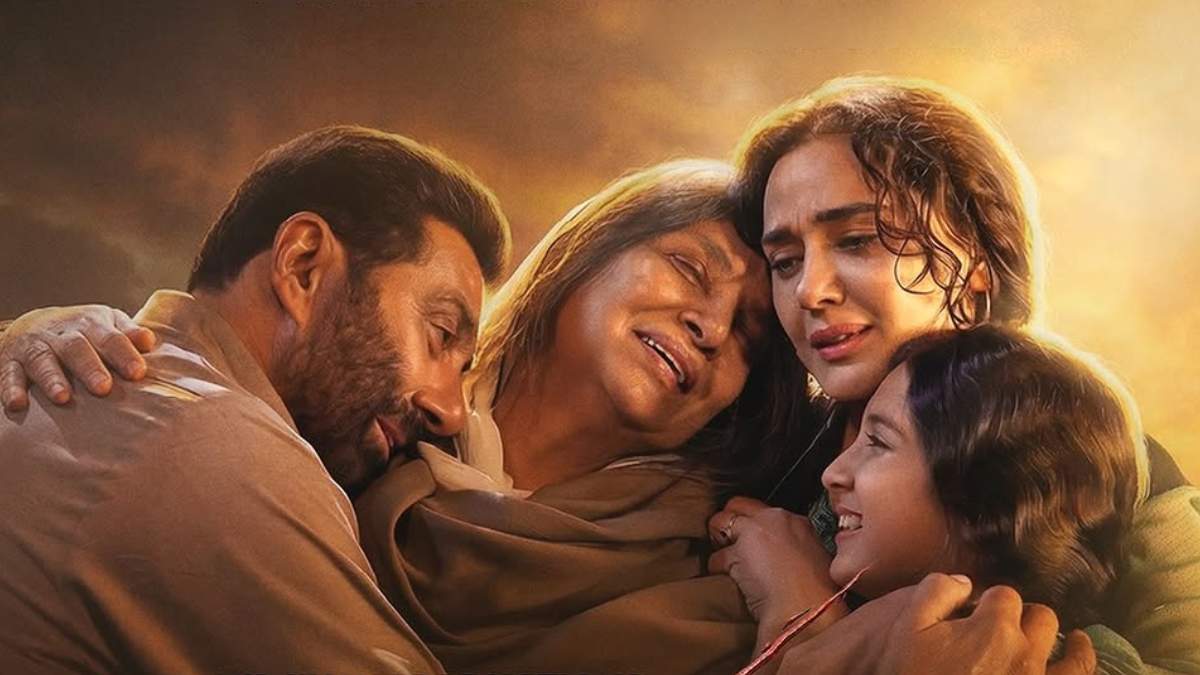
Batwara 1947 Movie Review: Sunny Deol & Shabana Azmi Turn Partition Into A Bigger Debate About Humanity
Star Cast: Sunny Deol, Preity Zinta, Karan Deol, Shabana Azmi, Ali Fazal
Director: Rajkumar Santoshi


Language: Hindi
Available On: Theatrical release
Runtime: 146 Minutes
What’s Good: The incisive script, powerful message and Shabana Azmi’s towering performance.
What’s Bad: The occasional return of Sunny Deol’s larger-than-life action persona.
Loo Break: Don’t partition this narration.
Watch or Not?: Surely yes.
Batwara 1947 Movie Review: What’s It About?
Set against the backdrop of India’s Partition, Batwara 1947 follows Sikandar Mirza (Sunny Deol), a wealthy businessman who is forced to leave India with his family after communal violence erupts.
During the chaos, his son Javed gets separated from the family while they make their way to Lahore.
In Lahore, Sikandar, his wife Hamida (Preity Zinta) and daughter Nishaat (Khushi Hajare) take refuge in a massive mansion called Durga Nivas.
But there is a catch.
The house originally belonged to Mai (Shabana Azmi), an elderly Hindu woman who refuses to leave because she is waiting for her missing son Ratan.
Initially, Sikandar wants Mai out.
Gradually, however, something changes.
Mai becomes close to Nishaat, then Hamida and eventually Sikandar himself. The family begins to see her not as a Hindu woman occupying their house, but as a mother.
Meanwhile, Javed returns after witnessing horrific violence and develops hatred towards Hindus. He becomes associated with Yakub (Abhimanyu Singh), an aspiring politician and fanatic who wants Mai expelled from Lahore.
What follows becomes much more than a Partition story.
It becomes a story about whether hatred inherited from history can overpower the humanity we discover in the people around us.
Batwara 1947 Movie Review: Script Analysis
Based on Asghar Wajahat’s play Jis Lahore Nai Vekhya, O Jamya E Nahin, the screenplay by Wajahat and Rajkumar Santoshi uses Partition as the foundation rather than the destination.
That is what makes the film interesting.
Batwara 1947 isn’t primarily interested in recreating the trauma of India and Pakistan’s separation. Instead, it asks a more uncomfortable question: what actually separates human beings?
Religion?
Or their choices?
The screenplay repeatedly reinforces the idea that an entire religion cannot be held responsible for the actions of individuals.
The relationship between Mai and the Mirza family becomes the emotional centerpiece of this argument.
A Hindu woman and a Muslim family, brought together by circumstances, gradually develop genuine affection and respect for one another.
The film’s emphasis on motherhood strengthens the message.
The idea that every child first says “Maa” before identifying with any religion becomes one of the screenplay’s most effective emotional observations.
The dialogues are simple but direct, allowing the message to land without excessive complexity.
The one major weakness comes whenever the film suddenly turns Sikandar into a one-man army.
His character is established as a wealthy businessman, yet some action sequences make him behave like a traditional Sunny Deol action hero.
Those moments feel disconnected from the otherwise grounded emotional drama.
Batwara 1947 Movie Review: Star Performance
Shabana Azmi is phenomenal.
As Mai, she brings extraordinary emotional depth to the film.
Her character begins as stubborn and resistant, but slowly reveals compassion, vulnerability and an immense capacity for love.
Azmi makes every stage of Mai’s emotional journey believable.
Her scenes with the Mirza family are easily among the film’s strongest moments.
Sunny Deol is at his best when he remains restrained.
His affection for Mai gradually becomes visible without requiring excessive dialogue or melodrama.
When the film allows him to simply be Sikandar rather than “Sunny Deol”, his performance becomes considerably more effective.
Preity Zinta makes a charming comeback and brings warmth to Hamida.
Karan Deol has some effective moments but still has considerable room to grow.
Ali Fazal is excellent as Habib, bringing sincerity and warmth to a fundamentally good-hearted character.
Abhimanyu Singh performs his role effectively, although his villainy occasionally feels conventional.
The supporting cast also contributes effectively to the film’s emotional world.
Batwara 1947 Movie Review: Direction & Music
Rajkumar Santoshi makes a strong return with Batwara 1947.
The director chooses compassion over spectacle and allows the relationships to drive the narrative.
The film’s greatest achievement is that it doesn’t turn its message into a simple lecture.
Instead, it demonstrates its philosophy through the evolving relationship between Mai and the Mirzas.
The communal tension remains important, but the film consistently returns to its central argument: humanity should come before religious identity.
The background score by A.R. Rahman is notably restrained.
It does not constantly announce the emotion or manipulate the audience into feeling something.
The songs, however, don’t leave much of an impression.
Batwara 1947 Movie Review: What Works
The biggest strength of Batwara 1947 is its central idea.
The film argues that the real Partition isn’t necessarily between India and Pakistan, or between Hindus and Muslims.
The real division is between good and bad human beings.
That is a simple idea, but the film communicates it with considerable emotional force.
The relationship between Mai and the Mirza family gives this philosophy a human face.
The film also makes motherhood a universal emotional bridge between communities.
Rather than asking people to merely tolerate another religion, it makes a stronger argument: respect and love should exist beyond religious identity.
Batwara 1947 Movie Review: What Doesn’t Work
The film occasionally slips into conventional Bollywood territory.
Sunny Deol’s superhero-like action moments are particularly jarring because they don’t fit the character established earlier.
Some sections could also have benefited from tighter pacing.
However, these issues don’t significantly diminish the emotional impact of the overall narrative.
Batwara 1947 Movie Review: The Last Word
Despite its title, Batwara 1947 isn’t really an India-Pakistan nostalgia story.
It is a story about people.
About a Hindu woman who becomes a mother figure to a Muslim family.
About a son whose experience of violence turns into hatred.
About a family that chooses love over inherited prejudice.
And ultimately, about the idea that religion does not determine whether someone is good or bad.
Shabana Azmi delivers a magnificent performance, Sunny Deol finds surprising restraint, Preity Zinta makes a warm comeback and Rajkumar Santoshi returns with a compassionate piece of cinema after a long gap.
Batwara 1947 doesn’t ask us merely to tolerate people of other faiths. It asks us to respect them. And that distinction makes all the difference.
Rating: 4/5 Stars
Frequently Asked Questions
What is Batwara 1947 about?
Batwara 1947 is a Partition-era drama about a Muslim family in Lahore that develops a deep bond with Mai, a Hindu woman who refuses to leave the family home where she is waiting for her missing son.
Is Batwara 1947 based on a true story?
The film is based on Asghar Wajahat’s play Jis Lahore Nai Vekhya, O Jamya E Nahin. The review describes it as a fictional narrative using the Partition and its aftermath as its backdrop.
Who stars in Batwara 1947?
The film stars Sunny Deol, Shabana Azmi, Preity Zinta, Karan Deol and Ali Fazal, with Abhimanyu Singh and others in supporting roles.
Is Batwara 1947 a Partition movie?
Yes, but the film uses Partition primarily as the backdrop for a larger story about humanity, religious harmony, motherhood and the division between good and bad people.
Is Batwara 1947 worth watching?
Yes. The film is particularly recommended for viewers who enjoy serious, message-driven dramas. Shabana Azmi’s performance and the film’s central message are its biggest strengths.