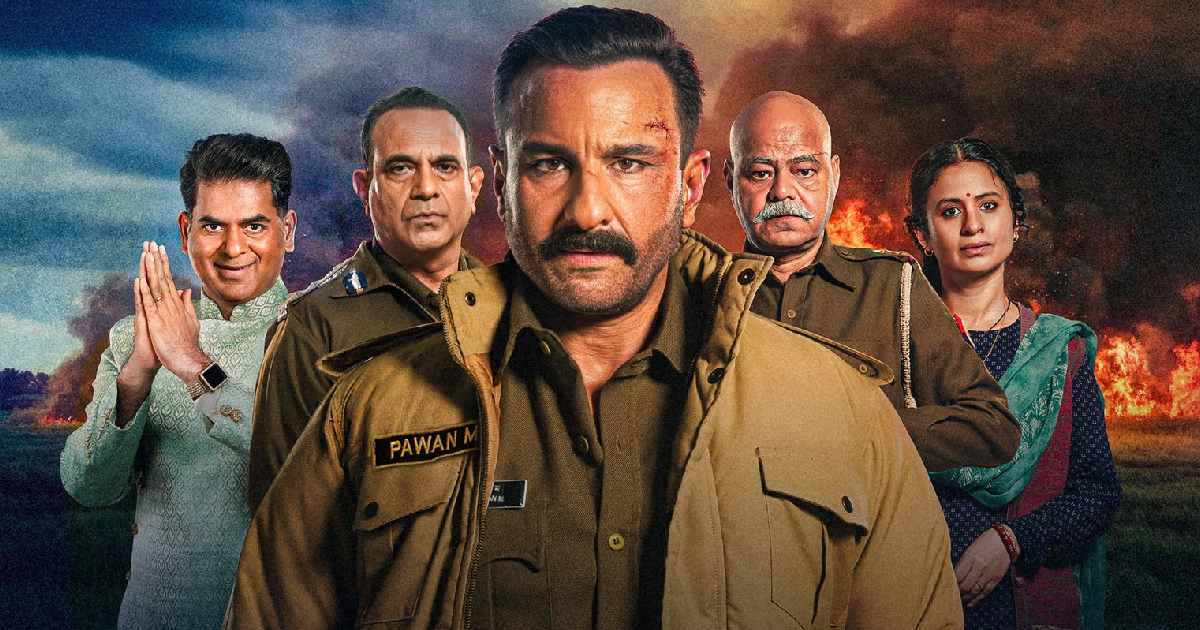
Kartavya Review: Saif Ali Khan Elevates An Ambitious Film That Never Fully Comes Together
Some films disappoint because they are poorly made. Others frustrate because they contain the ingredients of something remarkable but never quite find the right balance. Kartavya belongs firmly in the second category.
Directed by Pulkit, the film tackles weighty themes such as caste discrimination, abuse of power, institutional corruption, and personal morality. It aims high and deserves credit for that ambition. Yet, despite its noble intentions, the film often feels like two separate stories competing for attention rather than one cohesive narrative.
What ultimately keeps Kartavya afloat is Saif Ali Khan. His performance is so nuanced, restrained, and emotionally rich that he frequently makes you forget the film’s shortcomings. For brief moments, you stop noticing the uneven screenplay and simply watch a masterful actor at work.
Kartavya Review: Story & Screenplay
Set in the fictional town of Jhamli, Kartavya explores a society weighed down by caste-based violence, political influence, and deep-rooted social divisions. At the center of the story is SHO Pawan Malik (Saif Ali Khan), a police officer trying to navigate a system that seems determined to reward compromise over integrity.
As Pawan investigates a disturbing case involving power, prejudice, and manipulation, he finds himself trapped between professional duty and personal survival. Every decision comes with consequences, forcing him to constantly question what justice truly means.
Alongside this primary narrative runs another storyline involving ordinary people caught in extraordinary circumstances. While both tracks are individually compelling, the film struggles to weave them together effectively. Instead of complementing one another, they often interrupt each other’s momentum.
The result is a film that repeatedly pulls viewers in one direction before abruptly shifting focus elsewhere. The themes are powerful, but the storytelling lacks the cohesion needed to maximize their impact.
Saif Ali Khan Delivers One Of His Finest Performances
Saif Ali Khan is the film’s biggest strength.
His portrayal of SHO Pawan Malik avoids every cliché associated with the “heroic cop” archetype. There are no dramatic speeches, no larger-than-life action sequences, and no attempts to manufacture heroism. Instead, Saif presents a man worn down by years of compromise, disappointment, and emotional exhaustion.
What makes the performance exceptional is its restraint. Pawan’s anger rarely explodes. His frustration remains buried beneath silence, tired expressions, and carefully measured reactions. Saif communicates volumes through subtle gestures, proving once again why he remains one of Hindi cinema’s most underutilized performers.
Had the screenplay matched the quality of his performance, Kartavya could easily have featured one of the year’s most celebrated characters.
Sanjay Mishra is equally reliable. As always, he brings authenticity and sincerity to every scene, making even ordinary moments feel genuine.
Rasika Duggal leaves a strong impression despite limited screen time, adding emotional weight whenever she appears. Meanwhile, Zakir Khan contributes effectively to the film’s mystery elements. Saurabh Dwivedi shows promise but struggles to leave a lasting impact in a role that demands greater depth.
Direction & Technical Aspects
Pulkit demonstrates clear directorial talent throughout the film.
His understanding of atmosphere, tension, and emotional discomfort is evident in several scenes. He allows conversations to breathe and trusts viewers to absorb the complexities of the situations presented.
However, that same confidence occasionally works against the film. The pacing often becomes sluggish, and prolonged stretches of silence or contemplation begin to dilute the emotional intensity rather than strengthen it.
The screenplay’s biggest problem remains structural. Both central storylines contain enough substance to support their own standalone films.
One could have focused entirely on Pawan Malik’s internal struggle against caste bias, corruption, and moral fatigue. The other could have explored his fight against institutional abuse and the consequences of misplaced trust.
Individually, both narratives possess significant dramatic potential. Combined into a single feature, neither receives the attention it fully deserves.
Final Verdict
Kartavya is a film filled with strong ideas, relevant social commentary, and memorable performances. Yet it never fully realizes its potential because it cannot decide which story it truly wants to tell.
The narrative frequently shifts between political drama, investigative thriller, social realism, and psychological character study without fully committing to any one direction. This lack of focus weakens the emotional payoff and creates a sense of fragmentation.
Despite these flaws, the film remains worth watching for one reason: Saif Ali Khan.
His portrayal of SHO Pawan Malik is intelligent, understated, and deeply affecting. There are moments when he completely transcends the material, carrying the film through sheer force of performance.
Kartavya may not be the film Saif Ali Khan deserves, but his performance alone makes it difficult to ignore.
Frequently Asked Questions (FAQs)
1. What is Kartavya about?
Kartavya follows SHO Pawan Malik, a police officer navigating a system plagued by caste discrimination, corruption, and political influence while investigating a case that challenges his sense of duty and morality.
2. Is Kartavya based on a true story?
No, Kartavya is a fictional story. However, it draws inspiration from real social issues such as caste-based violence, abuse of power, and systemic failures.
3. How is Saif Ali Khan’s performance in Kartavya?
Saif Ali Khan delivers one of the strongest performances of his career. His portrayal of SHO Pawan Malik is subtle, emotionally layered, and grounded, making him the standout element of the film.
4. Where can I watch Kartavya?
Kartavya is available for streaming on Netflix.
5. Is Kartavya a thriller or a social drama?
The film blends multiple genres, including investigative thriller, social drama, political commentary, and psychological character study.
6. What are the major strengths of Kartavya?
The film’s biggest strengths are Saif Ali Khan’s performance, its socially relevant themes, strong supporting performances, and Pulkit’s atmospheric direction.
7. What are the weaknesses of Kartavya?
The primary criticism lies in its fragmented screenplay. The film attempts to tell two significant stories simultaneously, which dilutes the impact of both narratives.
8. How long is Kartavya?
The film has a runtime of approximately 1 hour and 48 minutes.
9. Is Kartavya worth watching?
Yes, especially for viewers who appreciate character-driven dramas and strong performances. While the screenplay has flaws, Saif Ali Khan’s performance makes the film worth the watch.
10. Who are the main cast members in Kartavya?
The film stars Saif Ali Khan, Sanjay Mishra, Rasika Dugal, Manish Chaudhari, and Saurabh Dwivedi in pivotal roles.
11. What themes does Kartavya explore?
The film examines duty versus morality, caste prejudice, institutional corruption, abuse of authority, personal guilt, and the challenges of upholding justice within a flawed system.
12. What is the overall rating for Kartavya?
Kartavya earns 3 out of 5 stars. It is an ambitious film with meaningful ideas and excellent performances, but its storytelling lacks the focus needed to fully deliver on its potential.


Comments are closed, but trackbacks and pingbacks are open.